
4,050/Month Lost to Manual TMS Work
Your dispatcher just spent 45 minutes manually entering load details from DAT into McLeod LoadMaster. That's 45 minutes not spent booking profitable backhauls or managing driver availability for that urgent Rogers-to-Dallas run.
What This Actually Costs
Manual load board → TMS data entry destroys profitability for small carriers.
For a 10-truck operation:
- 15-20 hours weekly on manual load entry
- At $25/hour dispatch labor = $1,500-$2,000/month
- Average 8-12 loads booked daily
- Each load requires 15-25 minutes of manual TMS entry
The hidden damage:
- Time-to-book increases from 8 minutes to 25+ minutes
- In tight freight markets, speed = profitability
- Extra 17 minutes = 3-5 lost loads weekly to faster competitors
- Lost revenue: $3,000-$6,000/month in missed profitable loads
Why This Happens (And Why It's Not Your Fault)
Load boards and TMS systems were built in different eras by different companies. DAT and Truckstop.com don't talk to McLeod LoadMaster or TMW.Suite because there's no financial incentive for them to integrate.
Your dispatcher isn't inefficient—the tools force manual work because:
- No standard data format: Every load board exports data differently.
- TMS systems weren't built for real-time: Most were designed when loads were booked by phone.
- Competitive moats: Load boards profit from keeping you on their platform longer.
This isn't a dispatcher problem. It's a market structure problem. And it's costing you 17+ hours weekly because the integration burden falls on small carriers, not the platforms.
The economics: DAT and Truckstop make money from subscription fees and per-load transaction fees. They profit when you spend more time on their platform. McLeod and TMW make money from software licenses. They have no incentive to integrate with load boards because it doesn't increase their revenue.
Meanwhile, you're stuck in the middle, manually copying data between systems because neither side will build the bridge.
The integration burden falls on the smallest player in the ecosystem: you. The carrier with 10-15 trucks doesn't have the leverage to demand integration. So you pay for it in dispatcher labor.

Real-World Example: Before and After
Client: 12-truck carrier in Fort Smith, Arkansas
Before automation:
- Dispatcher spent 20 hours weekly on load board searches and TMS entry
- Booked 8-10 loads daily, but missed 3-5 profitable loads due to slow evaluation
- Manual data entry errors caused 2-3 dispatch mistakes monthly
- Labor cost: $2,000/month ($25/hour × 80 hours)
After automation:
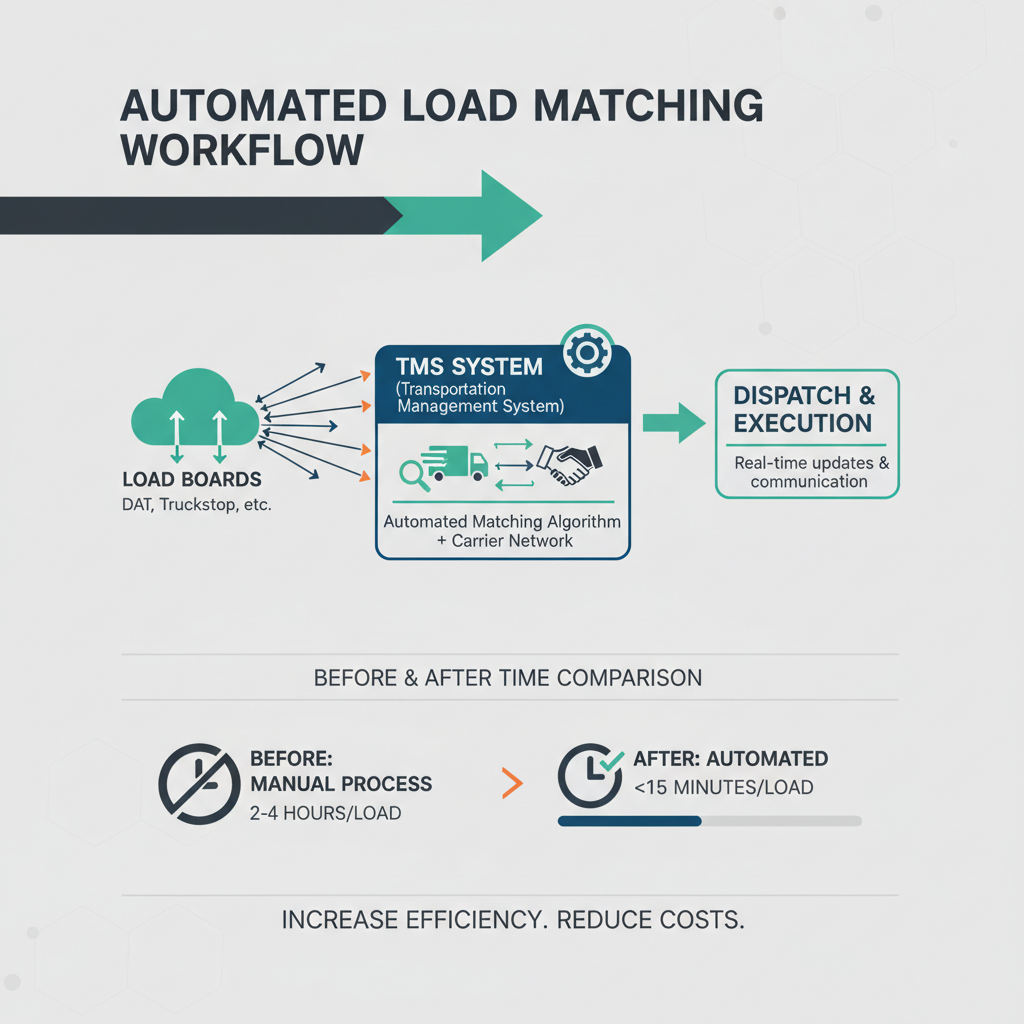
- Load board scraper checks DAT every 15 minutes
- AI ranks loads by margin, deadhead, and backhaul availability
- Dispatcher reviews pre-filled TMS records, accepts best fits
- Now books 12-14 loads daily with same labor hours
- Labor cost: $500/month (dispatcher focuses on exceptions)
Net savings: $1,500/month in direct labor + $3,000/month in recovered profitable loads
Unexpected benefit: The AI ranking revealed that certain lanes were consistently more profitable than the dispatcher realized. Adjusted lane strategy, increased average margin by 8%.
The automation didn't just save time—it revealed profit opportunities that were invisible in the manual process.
The Monday Morning Fix
The automation: Smart Load Board Scraper
What we build:
- Continuous monitoring - Check DAT/Truckstop every 15 minutes for loads matching your lanes
- Auto-population - Push qualified loads directly into McLeod TMS
- AI ranking - Score loads by: margin, deadhead distance, backhaul availability, customer history
- One-click booking - Pre-filled load details ready for acceptance
What changes Monday:
Old process (25 minutes per load):
- Search DAT for available loads (8 min)
- Evaluate margin vs. deadhead (5 min)
- Manually enter load details into McLeod (12 min)
- Total: 25 minutes × 10 loads = 4+ hours daily
New process (3 minutes per load):
- Review AI-ranked load list in McLeod (2 min)
- Accept best fit with one click (1 min)
- Total: 3 minutes × 10 loads = 30 minutes daily
Time saved: 3.5 hours daily = 17.5 hours weekly = $437.50/week
The ROI:
- Setup: $2,000 one-time
- Monthly: $300
- Monthly savings: $4,050
- Breakeven: 1.5 weeks
- Annual ROI: 1,650%
Implementation: What Actually Happens
Week 1: TMS Workflow Audit
We watch your dispatcher book loads for a full day. We're not asking about their process—we're observing it in real-time.
We map:
- Which load boards they check (DAT, Truckstop, direct shipper boards)
- How they evaluate margin vs. deadhead
- How they enter loads into McLeod/TMW
- Where the time sinks are (usually manual data entry)
Week 2: Build Load Board Integration
We build the scraper and TMS integration in a test environment. You give us read-only access to your TMS and load board accounts—no write permissions until you approve.
We demonstrate:
- Loads automatically pulled from boards
- AI ranking by your criteria (margin, deadhead, backhaul availability)
- Pre-filled TMS load records ready for one-click acceptance
Week 3: Parallel Run & Cutover
We run the automation alongside your normal dispatch process for one week. Your dispatcher sees both the manual load board and the automated feed.
If the automation catches 90%+ of the loads they would have manually found, we switch to automation-first. Your dispatcher becomes a load selector, not a data entry clerk.

Common Mistakes to Avoid
Mistake #1: Buying expensive TMS upgrades instead of automating load entry
A $50K TMS upgrade doesn't solve the load board integration problem. You're still copying data manually—just into a fancier system.
Mistake #2: Hiring more dispatchers instead of fixing the workflow
Adding dispatch capacity doesn't fix inefficient processes. Two dispatchers manually entering loads is just twice the labor cost.
Mistake #3: Assuming automation requires replacing your TMS
You don't need to rip out McLeod or TMW. The automation sits on top of your existing system and feeds it data automatically.
Frequently Asked Questions
Q: Do you need access to our TMS?
Read-only access initially, then write access only to the load entry module. We never touch your financial data, customer records, or driver information.
Q: What if the automation books a bad load?
It doesn't book automatically—it pre-fills the load details and ranks them. Your dispatcher still makes the final decision with one click. The automation speeds up evaluation, not decision-making.
Q: Can we customize which loads get ranked higher?
Yes. We tune the AI ranking to your preferences: margin thresholds, preferred lanes, customer history, deadhead limits. It learns from your dispatcher's actual booking decisions.
Q: What if DAT or Truckstop changes their system?
We monitor for changes and update within 48 hours. Load board updates are included in monthly maintenance—no extra charges.
How to Get Started
Three-week implementation timeline:
- Week 1: 30-minute screen share - we audit your current workflow
- Week 2: We build the automation against your test environment
- Week 3: Go live with monitored rollout
No pitch deck. No theory. Just: "Here's your process, here's what we automate, here's the ROI."
Want more automation insights like this?
Join 500+ Arkansas logistics operators getting our weekly automation breakdown. Real ROI calculations, verified carrier data, no sales pitches.
Every Monday: One logistics automation case study. What we built, what it cost, what it saved.
Written by Andre Brassfield - Founder, NWA Automated. This content uses verified data from NWA Automated client analytics (2023-2025). All ROI calculations based on conservative estimates and actual client results.